

Methodology
The evidence behind what’s worth taking.
Stakkaz is built to turn supplement research into stack decisions.
Most platforms stop at information: a study summary, a supplement article, a chatbot answer, or a list of ingredients that might help. Stakkaz goes further. It evaluates human evidence, maps that evidence to specific outcomes, weighs uncertainty, and uses that foundation to surface the add, swap, or dosage adjustment most likely to improve the outcomes behind your goal.
The optimizations and scores in Stakkaz build from the evidence described here, then apply dosage, safety, product analysis, medication, condition, allergen, dietary, and current-stack logic.
- supplementation-related papers in the research library
- 255,602supplementation-related papers in the research library
- human trials and reviews used directly in optimization
- 8,564human trials and reviews used directly in optimization
- results-bearing papers with a numeric Evidence Rating
- 50,979results-bearing papers with a numeric Evidence Rating
Stakkaz is evidence-based decision support, not medical advice, diagnosis, or treatment.
The question we are trying to answer
A lot of supplement content asks:
Is there evidence this supplement helps?
That question sounds evidence-based, but it is too blunt to support a real stack decision.
A supplement can look helpful for one endpoint, irrelevant for another, useful in deficient participants, useless in already-replete users, meaningful at one dose, unsafe or unrealistic at another, and overstated when the comparator, population, or outcome does not match the decision being made.
Stakkaz starts from a harder question:
Given the human evidence, which intervention is most likely to improve the outcome for someone with this context, after accounting for evidence quality, dose, relevance, overlap, and uncertainty?
Answering that question helps you decide what’s worth taking.
What follows walks through how, with one real analysis: a strength-and-muscle stack of whey protein, fish oil and magnesium.
01
We start with human supplement evidence

The evidence is organized by goal, focus and population before anything is compared. We start by identifying research that is actually relevant to supplement decisions.
A paper is not treated as useful just because it mentions a nutrient, pathway, biomarker, animal model, or mechanism. The first question is whether the paper contributes human supplement evidence that can reasonably inform an intervention decision.
Published research coverage, reviewed September 8, 2026: our research library contains 255,602 supplementation-related papers. Of these, 8,564 human trials and reviews pass our quality thresholds and have structured extraction used directly in optimization. Our September 2, 2026 Evidence Rating snapshot includes 50,979 results-bearing papers with a numeric rating.
Additionally, we establish a minimum study design quality threshold grounded in our evidence rating.
Not every output is a formal systematic review. The goal is more practical: apply the habits of evidence-based review at product scale.
02
We extract the details that determine what a study means
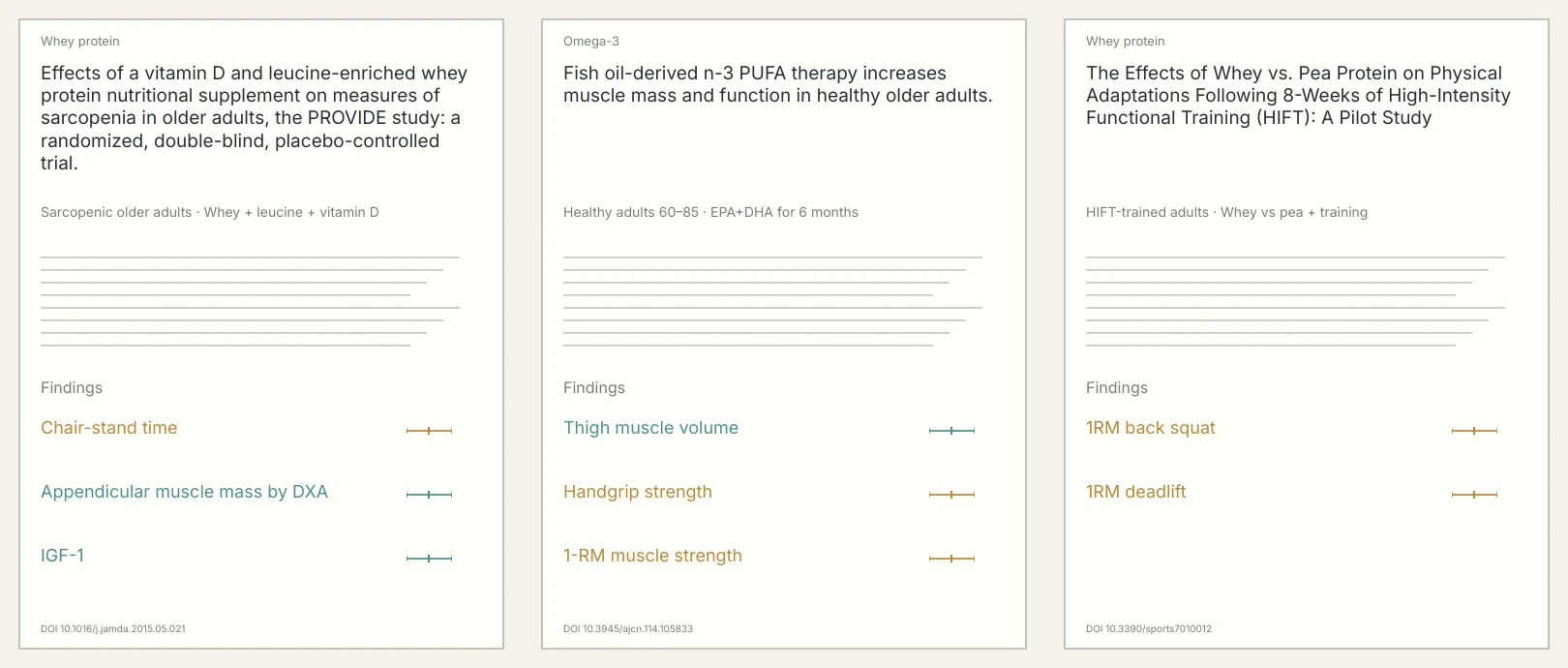
Three human trials from the example, each kept with its population, intervention and measured findings. A study summary is not enough for a supplement decision.
We extract structured facts from papers, including:
- intervention arms
- active ingredients and forms
- sample sizes
- demographics
- health status and baseline context
- dose and duration
- measured endpoints
- comparator type
- timing
- direction of effect
- magnitude where available
- adverse events and attrition where available
We are intentionally conservative during extraction. Missing information stays missing. An unclear dose is not guessed. An unclear comparator is not silently treated as placebo. A broad conclusion is not converted into a stronger claim than the paper supports.
03
We map study endpoints to real outcome areas
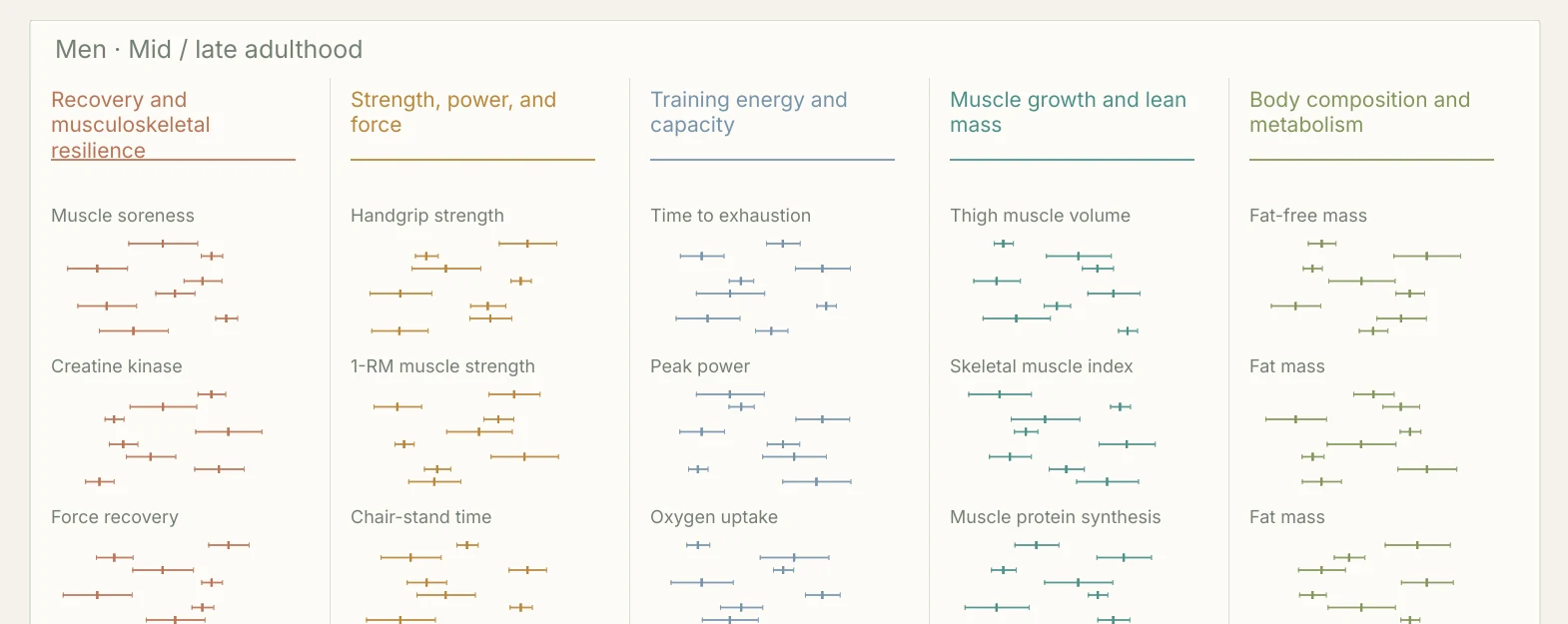
Endpoints from many trials, grouped into the outcome areas behind one goal, for one population: men in mid to late adulthood. Supplement studies rarely measure the same thing in the same way.
One sleep study might measure sleep latency. Another might measure subjective sleep quality. Another might measure total sleep time, HRV, next-day cognition, or a stress biomarker. Those endpoints can all be relevant, but they are not interchangeable.
We map raw study endpoints into broader groups of outcomes. A central endpoint gets more credit than a weak proxy. A specific outcome gets more credit than a vague wellness-adjacent marker. Evidence is strongest when the measured endpoint closely matches the outcome the user cares about.
This prevents a common supplement-marketing failure mode: treating any related biomarker as proof for a much broader claim.
The methodological reason is straightforward. Research becomes easier to compare when outcomes are measured and reported consistently. COMET's core outcome set work exists for a similar reason: it defines agreed standardized outcomes that should be measured and reported, at minimum, in trials for a specific area of health care.
04
We account for dose, timing, comparator, and baseline status
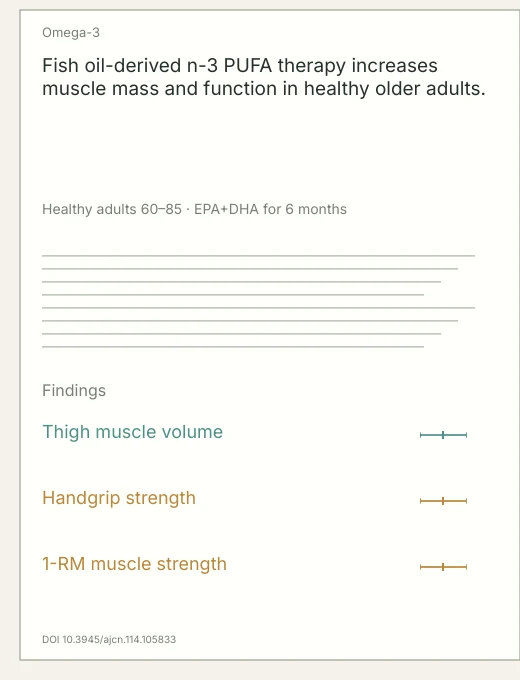
Each finding keeps its context: healthy adults aged 60 to 85, taking EPA and DHA for six months. A supplement result does not mean much without context.
Comparator, dose, timing, and baseline status all change what a finding means. A benefit versus placebo is not the same as a benefit versus baseline. A no-effect result at the wrong dose, after too little time, or in people who already had adequate status should not be treated as proof that an intervention cannot help.
We use those details to avoid treating all positive or negative findings as equal.
05
We avoid counting the same evidence twice
What the stack already supports
Optimum Nutrition Gold Standard 100% Whey, Thorne Super EPA Pro, Thorne Magnesium Bisglycinate
- Strength, power, and force63
Whey 57 · Super EPA Pro 6
- Muscle growth and lean mass70
Whey 49 · Super EPA Pro 21
- Training energy and capacity53
Whey 43 · Magnesium Bisglycinate 10
- Body composition and metabolism83
Whey 68 · Super EPA Pro 15
- Recovery and musculoskeletal resilience24
Whey 13 · Magnesium Bisglycinate 11
One analysis of a three-product strength-and-muscle stack. Each meter shows how much of the available, research-backed support for that outcome the stack captures, allocated across the products that earn it, so evidence they share is credited once. Meters describe support, not measured effects. Supplement research can easily look stronger than it is.
One paper may report many related endpoints. A review may include trials already represented elsewhere in the evidence base. A combination study may test several ingredients at once, making it hard to know which component drove the effect. Related supplement forms may overlap without being identical.
We group related evidence, track overlap, and discount support when the evidence is correlated or difficult to attribute.
06
We favor evidence that survives uncertainty
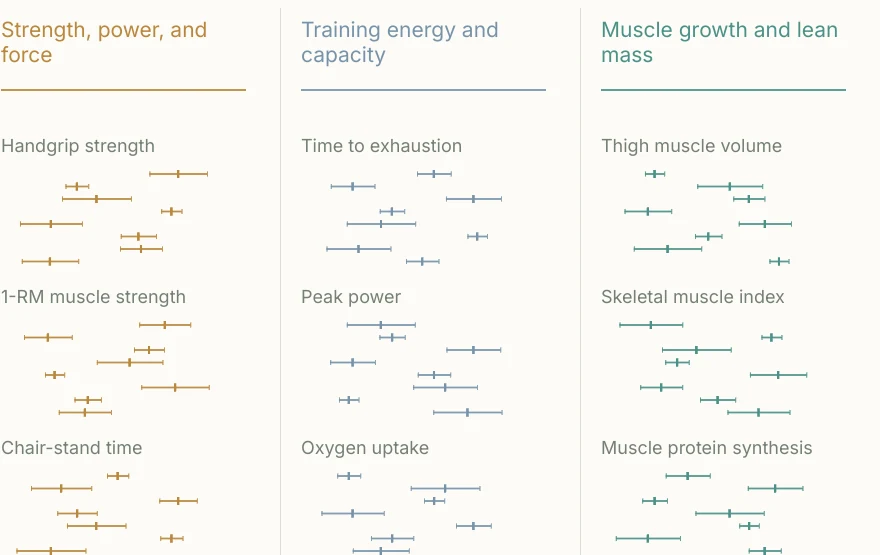
Each mark is one finding, drawn with a range. The geometry is illustrative, not plotted confidence intervals. We do not just look for the supplement with the highest apparent upside, the most papers, or the largest headline effect.
More research is useful, but quantity alone is not enough. A heavily studied supplement can still have mixed results, weak endpoints, small effects, poor population fit, or evidence that does not apply well to the outcome being evaluated. A less-studied intervention can sometimes be more relevant if the available human evidence is more consistent, better measured, and more directly tied to goal and focus.
We favor interventions that still look useful after uncertainty is applied.
That means an intervention with one exciting but fragile study may carry less weight than an intervention with smaller, more consistent, better-supported effects. It also means a supplement with many papers does not automatically rise to the top if those papers are indirect, duplicated, low quality, or inconsistent.
Sparse evidence, weak endpoints, immature research areas, high dropout, unclear comparators, overlapping reviews, indirect populations, and possible publication bias all reduce confidence.
This is especially important in supplement research, where "more studied" does not always mean "more useful." The question is not how much research exists in total. The question is what the research shows, how consistent it is, how directly it maps to the outcome, and whether the expected benefit still holds up after uncertainty is accounted for.
07
Applied to you
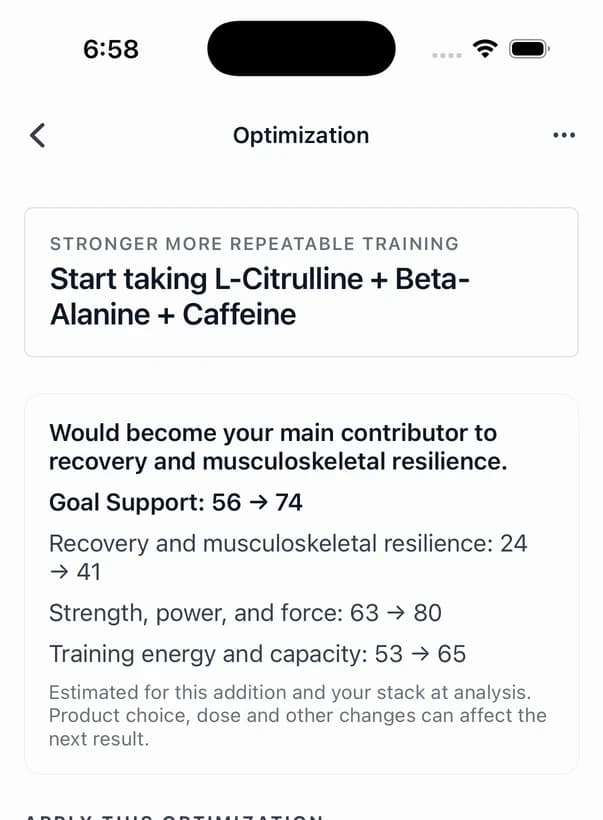
- Recovery and musculoskeletal resilience24 → 41
- Strength, power, and force63 → 80
- Training energy and capacity53 → 65
The comparison, applied to one person's goal and stack: adding L-Citrulline, Beta-Alanine and Caffeine is estimated to move Goal Support from 56 to 74, led by recovery. That is an estimate of the support the stack would capture, not a predicted change in health. The evidence does not point to the same supplements for everyone.
A study in older adults, deficient participants, trained athletes, healthy adults, or people with a specific condition does not mean the same thing for every user. Stakkaz matches evidence against your context, including your goal, current stack, doses, age, sex, medications, conditions, allergens, diet, and constraints, so evidence is used where it is most applicable and discounted where it is less relevant.
That is how Stakkaz moves from all the evidence to your evidence.
What the scores mean
The scores and meters measure opportunity, not effect. Goal Support reflects how much relevant, realistically available support your stack captures: support from interventions with positive human research for your goal, in your context.
Where there is less opportunity, because fewer interventions have that research, or because interactions, safety or your restrictions would limit what an intervention could realize, that is accounted for. What you cannot take is not held against you, and a strong score never depends on an ever-larger stack.
The analysis cannot know that adding another intervention for the same outcome will have the same effect. It shows how much of the research-backed opportunity your stack already captures, and what is left.
A higher score does not necessarily mean a better stack for you. It shows how much of the available support your stack captures; how far to go is your choice, weighed against what matters to you, what you are willing to spend and which trade-offs you want to make.
Limits of the evidence
Stakkaz does not know causal truth perfectly.
It is limited by the quality of the research literature, which papers have been ingested, how clearly studies report their methods, whether endpoints are meaningful, whether participant groups match the future user, and whether the published evidence is biased, incomplete, underpowered, or inconsistent.
The system is designed to make those limits matter.
When evidence is weak, confidence should fall. When evidence is indirect, it should not be treated as direct. When reviews overlap with the same trials, support should not be double-counted. When a study does not report enough detail, the system should not invent certainty.
That is the methodological standard behind Stakkaz:
Turn human supplement research into structured evidence, connect that evidence to real outcome areas, discount weak or duplicated support, and prioritize interventions that still look useful after uncertainty is accounted for.
Build a supplement stack worth taking.
See what human research means for your products, doses, goals, and next steps.
Related Methods
More on scoring, products, and quality.
Evidence Rating: How Stakkaz Scores Paper Quality
How paper-level research quality ratings are generated from methodological rigor and reliability.
Read more
How Stakkaz Selects Products for Stack Optimizations
How label fit, quality, suggested serving, profile filters, and value shape product choices.
Read more
Understanding Stakkaz Product Quality
How the product quality badge evaluates label transparency, testing signals, formula quality, and brand reliability.
Read more